

How We Do It
The depth behind a quality heat pump install.
Anyone can bolt a heat pump to a wall. Making it run beautifully — quiet, efficient and warm for decades — is a craft. Here is the engineering, in plain English, that separates a Greenmotion system from a box-swap.
4.5+
Target SCOP
0%
VAT on install
£7,500–£9k
BUS grant
MCS
Certified
The science, simplified
How a heat pump actually makes heat
A heat pump doesn’t create heat — it moves it. A special refrigerant travels endlessly around a sealed loop, picking up free warmth from the outside air and releasing it into your home. Watch it flow through the four stages below.
Stage 01
Evaporator
Outside, a very cold liquid refrigerant flows through the outdoor coil. Even freezing winter air is warmer than it is — so that free warmth boils the refrigerant into a cold gas. This is the clever bit: a heat pump harvests heat that is already in the air, it doesn’t burn anything to make it.
For every 1 unit of electricity the compressor uses, a good system delivers 3–4.5 units of heat.
The part nobody talks about
Your cylinder decides how efficiently your hot water is made
A heat pump is only ever as good as the cylinder it heats. Reusing the old cylinder that came with your gas boiler is the single most common reason a heat pump runs hot, slow and expensive. Here's the difference — watch all three reheat side by side.
Standard boiler cylinder
Designed for a gas boiler
Vaillant uniSTOR
Our standard fit — included with every install
Newark Super Cylinder
Custom upgrade add-on
The physics, in one line
Heat transfer = coil area × temperature difference × time
A gas boiler pushes 70–80°C water through the coil, so the temperature difference is huge and even a tiny coil reheats the tank. A heat pump runs much cooler water (~45–50°C) to stay efficient — so the temperature difference is small. The only way to get the heat in quickly is a far bigger coil. That's why the Super Cylinder uses 6.0 m² — up to six times the surface area of a standard cylinder.
Cold sits at the bottom
Cold water is denser, so it settles low while hot rises to the top — forming distinct layers (stratification). Good layering means you draw full-temperature water from the top the moment you need it.
The coil lives in the cold
Keeping the big coil low, in the coldest water, gives the biggest temperature difference — so the heat pump can run its lowest, most efficient flow temperature and still reheat fast.
A diffuser protects the layers
The Super Cylinder's 35mm cold-inlet diffuser slows incoming mains water so it doesn't churn the tank — keeping the hot/cold boundary razor-sharp.
Tall & slim beats short & fat
A taller, slimmer tank keeps hot and cold from mixing, so you get more usable hot water from every kilowatt the heat pump puts in.
Upgrading the cylinder is often the difference between a heat pump that just about copes and one that quietly delivers 400–550% efficiency on your hot water — every single day.
The Heat Geek method
Four principles that quietly do all the work
We’re trained in the Heat Geek approach — a design-first philosophy that treats a heat pump as one part of a whole system. Get these four things right and the unit on the wall almost looks after itself.
We measure, we don’t guess
Every install starts with a room-by-room heat-loss survey — measuring walls, windows, insulation and draughts. That single number decides everything: the size of your heat pump, your radiators and your pipes. Most cold, expensive systems fail here, at the very first step. We never skip it.
Low flow temperatures = low bills
A heat pump is happiest running warm water, not scalding water. The lower the temperature it has to produce, the less electricity it uses. We design your system to run at the lowest possible flow temperature your home allows — often the difference between an SCOP of 3.0 and a superb 4.5+.
Gentle heat, evenly spread
We size emitters so the water only drops a few degrees as it moves around your home — a low “delta-T”. That means every radiator runs at a similar temperature, no cold rooms, no hot spots, and a compressor that sips power instead of gulping it.
The system self-adjusts, all winter
With weather compensation, your heat pump reads the outdoor temperature and quietly trims its output every few minutes. You set it once and forget it. No boiler-style blasts of heat, just steady, background comfort that costs less to run.
Inside the install
The components we insist on — and why they matter to you
The heat pump is the headline. These are the quiet heroes plumbed in around it. Every one is chosen to protect your efficiency, your comfort and your investment. Here is what goes into a Greenmotion plant room.
Primary Pro armoured pipework
The pipes that carry heat between your heat pump and your home are the arteries of the system. We use pre-insulated, armoured Primary Pro trunking — UV-stable, weatherproof and rodent-resistant. It keeps precious heat in the water instead of leaking it into your garden, and it looks tidy for the life of the system.
SBR anti-vibration flexi-feet
A heat pump that hums through the wall is a heat pump nobody enjoys. We mount every unit on SBR rubber anti-vibration feet over a proper base, decoupling it from the building. The result is silence indoors and a rock-solid, level foundation that keeps the compressor running smoothly for decades.
Inta full-bore isolation valves
Small-bore fittings choke flow and rob a heat pump of performance. We plumb with full-bore Inta valves and correctly sized fittings so water moves freely at low pressure. It is invisible when it is done right — but it is one of the biggest reasons our systems out-perform a rushed install.
Heat-pump magnetic filter
A magnetic filter built specifically for heat pumps — a high-flow body with a powerful neodymium magnet that captures black iron-oxide sludge before it can foul the pump’s heat exchanger. Unlike a boiler filter, it is sized for the higher, continuous flow rates a heat pump runs at, so it protects efficiency without restricting the system.
Spirotech air & dirt separator
Air is the silent enemy of a low-temperature system — it causes noise, cold spots and cavitation. The Spirotech separator continuously strips out micro-bubbles and settles out dirt as the water flows through it, keeping the system de-aerated and clean for its whole life. It is a premium, VDI 2035-aligned component we fit as standard.
Anti-freeze frost-protection valves
Because the pipework runs outdoors, freezing is a real risk in a UK winter. We fit self-actuating anti-freeze valves that automatically dump a little water to keep the circuit moving if the temperature ever approaches freezing — a fail-safe that protects your investment even in a power cut, with no glycol penalty on efficiency.
Altecnic / Spirotech expansion vessel
As water heats it expands, and that pressure has to go somewhere. We size and fit a premium Altecnic or Spirotech expansion vessel with the correct pre-charge so the system holds a stable, safe pressure across every cycle. Correct expansion sizing is a detail cheap installs skip — and it is what keeps your system quiet, safe and long-lived.
Heat Geek Super Cylinder
A standard cylinder forces a heat pump to run hot and inefficiently to reheat your water. The Heat Geek Super Cylinder has a huge 6.0m² coil — far larger than normal — so it reheats fast at low flow temperatures. That one component can save around £181 a year versus a conventional tank.
Vaillant sensoCOMFORT weather control
This is the brain of the system. The sensoCOMFORT control runs the weather-compensation curve we tune to your home, manages your hot water and gives you simple app control. Set it and forget it — it does the thinking so your home stays warm for the least possible energy.
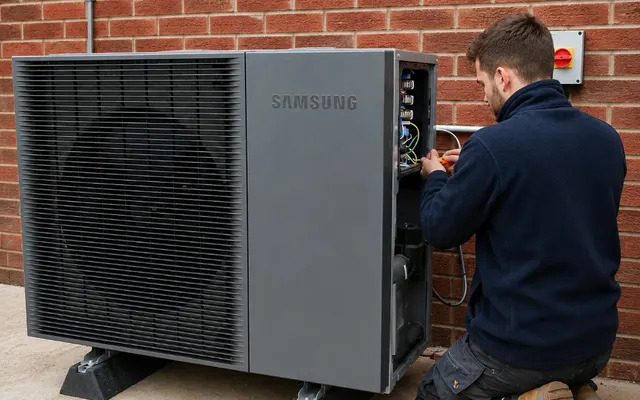
The final 10%
Commissioning is where good becomes brilliant
When the pipes are in, the real work begins. We balance every radiator, tune your weather-compensation curve to your home’s heat loss, purge and treat the water, and measure the finished performance against our design. You receive your MCS certificate, your BUS grant paperwork and a system you can genuinely set and forget.
FAQ
The questions we hear most
Absolutely. The R290 units we install operate efficiently down to −20°C, and some down to −25°C. Countries like Norway, Sweden and Finland have far higher heat pump adoption than the UK, with much colder winters.
Modern inverter units like the Vaillant aroTHERM plus run as low as 44 dB(A) — quieter than a fridge at typical distance. Our anti-vibration mounting means you won't hear it inside at all.
Usually not all of them. Because we design for lower flow temperatures, some existing radiators stay. Our heat-loss survey tells us exactly which rooms (if any) need a larger emitter — no guesswork, no blanket replacement.
A well-designed system with an SCOP of 4.0+ typically costs £800–£1,200 a year to heat an average 3-bed home — comparable to or less than gas at current prices, and the gap widens as our systems run more efficiently.
Most domestic air-source installs fall under Permitted Development and don't need planning permission. Exceptions include listed buildings and some conservation areas — we check this for you as part of the survey.
Ready to see what a proper system feels like?
Book your heat-loss survey for £250 — and it’s fully refundable when you go ahead with your installation. We’ll design a system properly for your home, with the grant and 0% VAT included.